
Procurement
Bakery Supplier Price Lists: Recording Versions and Effective Dates
A bakery supplier price list needs an identifiable version and a clear rule about when it applies.
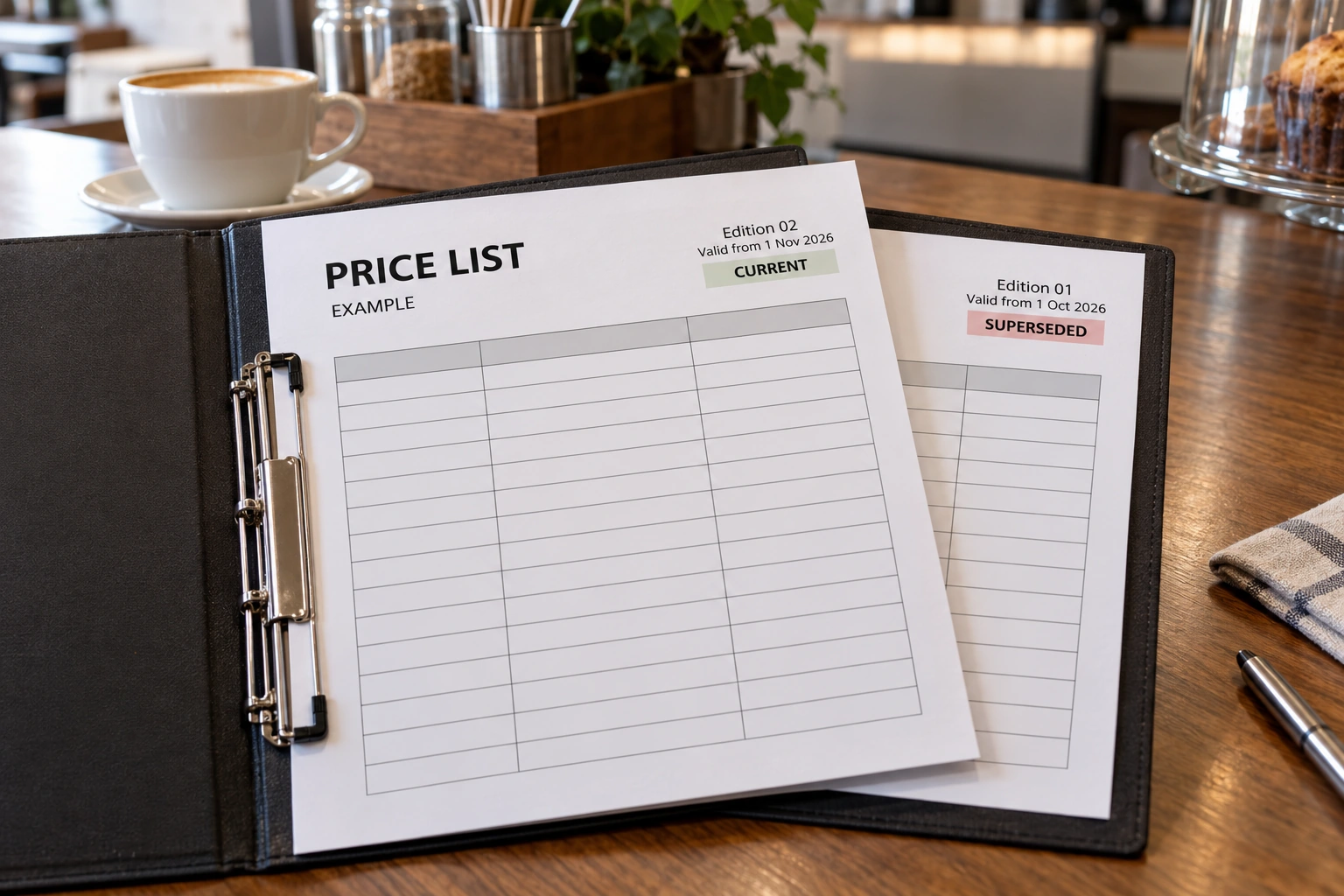
A bakery supplier price list needs an identifiable version and a clear rule about when it applies. A figure that was correct last month may not be the basis for the next order. Equally, receiving a new file does not automatically mean every previously approved order must be recalculated from it.
The aim is not to accumulate PDFs. The team needs to identify which list supports a particular order, the unit behind each price and any separately confirmed quotation. A short record helps procurement, outlet staff and administration work from the same agreement rather than competing copies.
Identify the list beyond its filename
Record the supplier, edition number or name, issue date and effective date where provided. Retain the source through which it was received, such as a business email or the official conversation accompanying the file. A filename such as “latest prices final” can be reused and does not reliably distinguish documents.
Where the supplier does not provide a version number, create an internal receipt reference linking the unchanged file to its sender and date. Do not edit the list and present the resulting document as though the supplier issued it. Internal annotations should remain distinguishable from original information.
CALPIA’s price-list page provides an example of edition history and effective dates. It demonstrates the value of explicit timing; that organisation’s pricing terms are not the terms for an Asa Group order or another supplier’s arrangement.
Confirm which transaction date controls the price
An order has several relevant dates: enquiry, quotation, confirmation, dispatch and receipt. Do not select one as the pricing basis without agreement. A useful question is: “Does this edition apply to orders confirmed from a particular date, or deliveries dispatched from that date?”
Record the answer and who confirmed it. If a staged delivery crosses a price-list change, ask whether the original agreement covers the full quantity or whether an approved split applies. A later date on a delivery note does not, by itself, establish a new price.
If the answer is unavailable, mark the pricing basis as awaiting confirmation. That status is more useful than passing an assumed figure to the outlet as a firm price. Identify the person following up and the orders dependent on the answer, so the unresolved question does not disappear into a general conversation.
Match the price to the item and ordering unit
Different lists may quote pieces, packs, cartons or another unit. Check the pack contents and variant before comparing numbers. A pack price cannot be directly compared with a price per piece simply because the product names look similar.
Retain the agreed item identity rather than only an outlet nickname. Where a product is renamed, connect the old name with the confirmed new identity. Do not assume the product is unchanged if weight, pack quantity or specification has also changed.
| Recorded detail | Question it answers |
|---|---|
| List edition | Which document was used? |
| Item and variant | What product is being priced? |
| Ordering unit | What quantity does the price cover? |
| Date basis | Which transactions does it affect? |
| Exception | Is there an approved special quotation? |
This small table can accompany an order summary without reproducing the entire supplier catalogue. Its purpose is to make the basis traceable when someone checks the transaction later.
Separate general lists from special quotations
A customer or project may have a separate quotation. Where one exists, link its reference, item scope, quantities and validity to the relevant order. Avoid copying a special figure into the general list, where it could be applied to a transaction outside the agreement.
Also identify components that are excluded or awaiting confirmation, according to the supplier’s information. Delivery charges and minimum conditions cannot be inferred from the appearance of a price table. A large-looking quantity is not evidence of an agreed discount.
When two documents appear inconsistent, do not immediately overwrite either one. Ask which document applies to the transaction and retain the traceable answer. A clear relationship between documents matters more than having one file described as the newest.
Make an edition change visible to the team
Keep the active reference in the agreed shared location. Mark the preceding edition as superseded for new orders while retaining its connection to historical transactions under the business’s document practices. Avoid distributing uncontrolled replacement copies into several folders without a responsible owner.
When an edition changes, summarise what affects the team: the effective date, altered items or units, and orders needing clarification. Ask the person preparing an order to verify the reference before forwarding quantities and prices for approval.
Try the practice with one example order. Ask another person to locate the source document, identify the unit and explain why that transaction uses a particular edition. If they find only a screenshot without a sender or date, improve the reference location and document links before unconfirmed figures spread across several outlets.
For a supply discussion with Asa Group, include the document edition and a specific question. Use the broader supplier-comparison guide to assess the wider arrangement, while keeping the price list as a transaction reference with an identifiable version and an agreed basis for use.