
Operations
Recording Outlet Feedback after a Bakery Menu Launch
Separate outlet observations, customer requests and follow-up decisions so a new bakery menu can be evaluated with clear context.
A new bakery menu needs evaluation beyond the first delivery to an outlet. After several days, the team may receive a mixture of comments: customers ask about portion size, staff struggle to explain a product name, or one variant repeatedly remains in the display. These notes become useful when their context stays intact. Without context, “not popular” can turn into a conclusion about the product even though placement, staff explanations or the observation period may be involved.
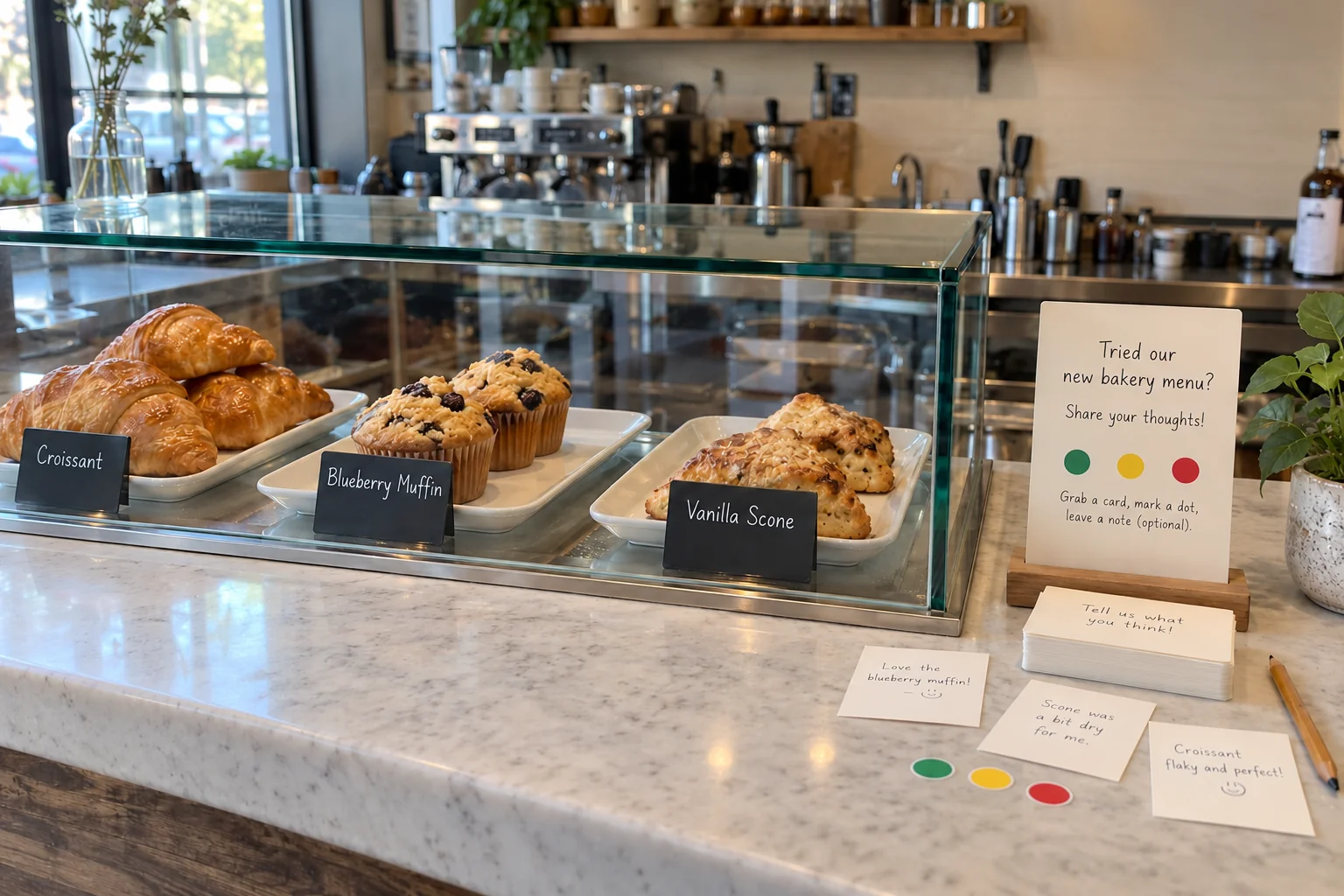
Decide which question the notes should answer
Start with one reasonably narrow operational question, such as whether customers understand the difference between two variants. This is more workable than asking how the entire new menu is performing. Agree on the outlet, date range and observation times before requesting feedback. Different locations do not necessarily have the same customer flow, display space or buying habits.
When several products launch together, give each item a consistent identity. Use its agreed product name rather than an informal description from a group conversation. One outlet might write “the new chocolate bun” while another uses a variant name. Those differences can make two observations about the same item appear unrelated. The guide to designing a product assortment for a business channel places the evaluation question within the broader product selection.
Separate events, comments and assumptions
Give the feedback form three short sections. The event section records what was actually observed: date, time, product and circumstances. The comment section captures customer or staff wording reasonably closely. The assumption section holds the recorder’s tentative explanation. Keeping these apart prevents an opinion from becoming a fact when someone else reads the summary.
For example, at 10.30 two customers asked whether variant A had a different filling from variant B. A staff comment says the display names do not explain the difference. The recorder’s assumption is that the display information needs clarification. This example does not establish a problem with taste or product quality. It gives the team a reason to examine information clarity before choosing a larger change.
Keep the form manageable during service
A lengthy form is difficult to use while serving customers. Choose a few fields that can be completed quickly: product identity, time, observation, the number of events actually recorded and the follow-up requested. Include a “not enough information yet” option so staff do not feel compelled to reach a conclusion. If nothing was recorded on a particular day, say that there are no notes; do not convert that absence into proof that there was no problem.
Avoid adding customer names, telephone numbers or private purchase details to the general recap. Menu evaluation usually needs patterns of questions and outlet context. A customer’s identity is not automatically necessary. If a complaint requires individual handling, send it through the appropriate service channel and keep it separate from the menu-observation recap. This keeps product discussions from absorbing unrelated personal service matters.
Group the notes while preserving their origins
Once several notes are available, group those addressing the same question. Comments about names and variant differences can belong to product information; comments about label position can belong to display clarity. Retain a connection to the original notes. A summary stating “five questions about variants” is more useful when the team can still find the outlet, time and wording behind it.
The number of notes is neither a sales measure nor a representative customer survey. An outlet that records carefully may appear to have more problems than one that rarely records anything. Before comparing locations, check whether they used comparable recording methods. Do not turn loosely collected comments into satisfaction percentages without a method that supports that interpretation.
Choose one observable next step
Select a small action that fits the observation. If customers cannot distinguish two variants, clarify the available information and brief the staff. If labels are difficult to see, examine their placement. Record who will carry out the action, when it starts and which observations will be used to review the result. Avoid changing names, display arrangements and explanations together when the original aim is to examine one possible cause.
Keeping the current arrangement while gathering more context can also be a valid decision. This is reasonable when notes are scarce or contradict one another. State why the team is waiting and when the discussion will reopen. Unresolved feedback does not need to disappear; it can remain marked “needs context” with a named owner.
Close the loop with the outlet
Send a short recap to the outlet that provided the observations: what the team received, which action was selected and what should still be recorded. Staff are more likely to maintain this habit when they can see how their notes contribute. If the action does not help, use the next observations to improve the decision rather than blame the earlier recorder.
For a new location, connect these notes to the outlet-launch supply plan. If the discussion concerns product suitability for a business channel, use the Asa Group contact information to share the requirement and outlet context. An orderly record gives the next conversation something concrete: which product, which question and which change is worth trying.