
Procurement
Checking a Bakery Invoice against the Order and Receipt
Check a bakery invoice against the approved order, received quantities, unit prices and documented differences before passing it for internal approval.
Check a bakery invoice alongside the latest approved order and the record of goods actually received. These documents answer different questions: what was ordered, what arrived, and what has been billed. A shared order number helps connect them, but it does not replace checking the individual lines.
This is useful when a café receives staged deliveries, uses several packaging units, or approves changes before dispatch. The aim is a traceable basis for internal approval. Payment terms, tax treatment and the resolution of differences still follow the applicable documents and agreements.
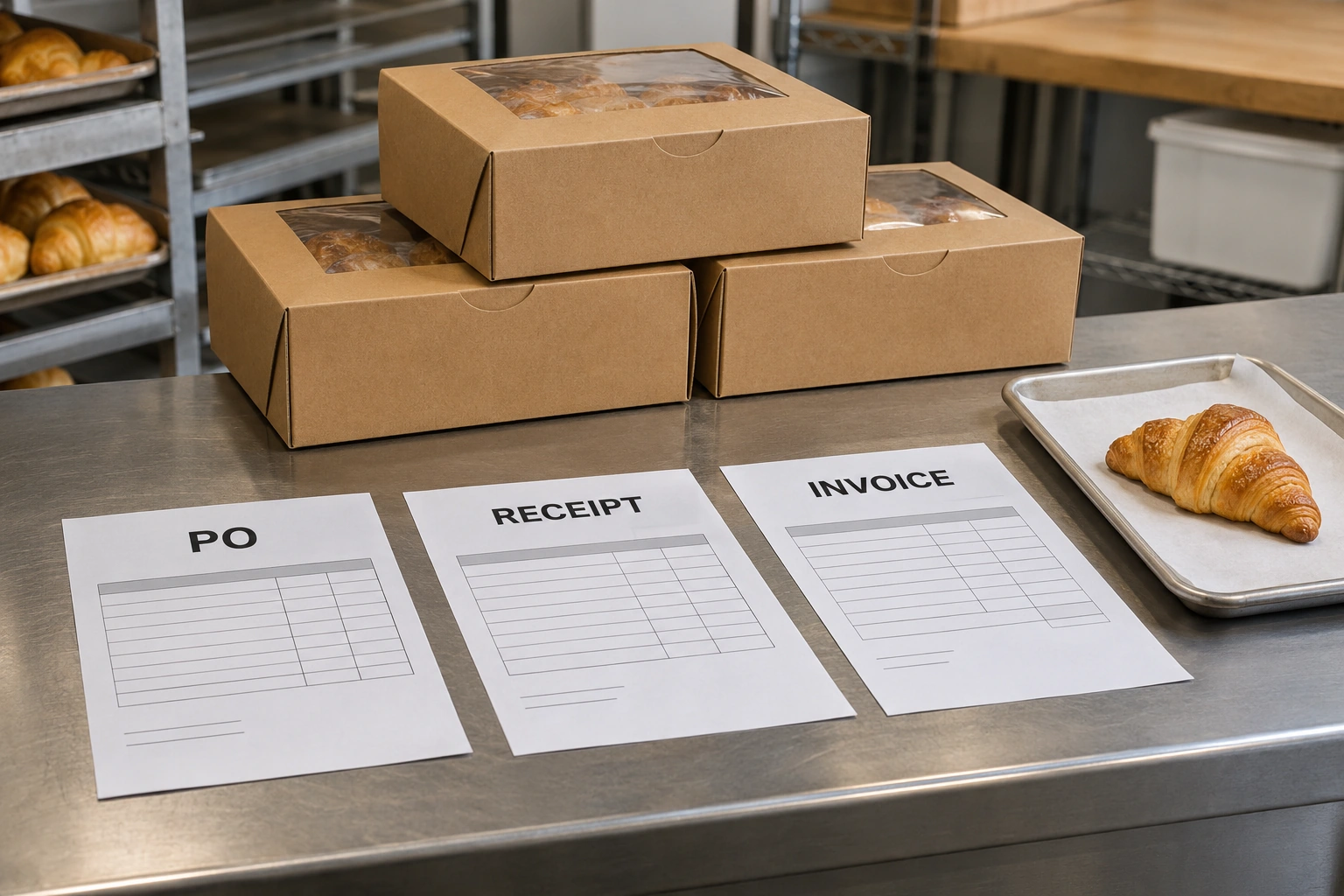
Connect documents for the same transaction
Start with the supplier identity, order reference, receiving location, delivery date and invoice number. If one invoice covers several delivery notes, list every relevant reference. Do not pair documents simply because their dates are close or their product names look similar.
Use the approved order version. An early conversation may show quantities or prices that were subsequently revised. Keep the change approval so the administrator can distinguish a final decision from an unanswered request. A proposed change is not automatically an accepted amendment.
Microsoft’s three-way matching documentation connects invoices, purchase orders and receipts. A bakery business can use that relationship as a simple checking framework without adopting the same software or copying another organization’s approval policy.
Compare the billed quantity with the receipt
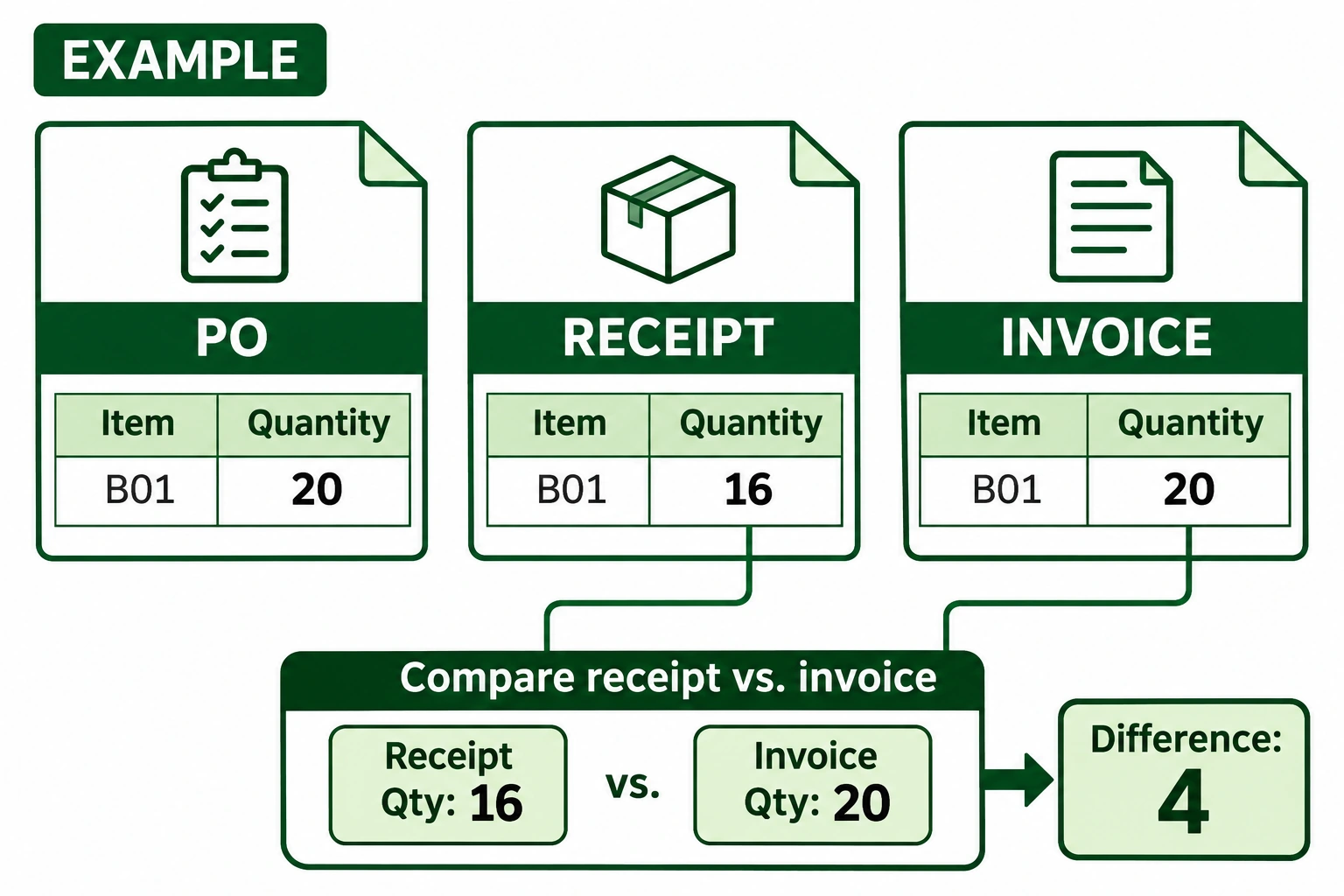
Suppose an order lists 20 boxes, today’s receipt records 16, and the invoice lists 20. Record the four-box difference and its current status. Another delivery may be planned, a receipt may be missing, or the invoice line may need correction. Confirm the explanation rather than choosing one yourself.
Check units before subtracting quantities. Two cartons and 24 boxes can describe the same quantity if the agreed carton content is 12 boxes. Conversely, two documents using the word “pack” may refer to different contents. Write the agreed conversion beside the relevant line.
For staged receipt records, see the guide to reconciling delivery notes with orders. Once the delivered quantity is established, the invoice review can focus on what has been billed instead of repeating the whole receiving process.
Compare prices using the same unit
Compare the net unit price with the applicable quotation or approved order. A per-piece price cannot be compared directly with a per-box price until the box contents are known. Include the product variant and size; a broad product-family name may conceal an important difference.
Keep product prices separate from other agreed charges, such as delivery or a specific packaging requirement. Ask for the basis of charges that cannot be found in the reference documents. Do not assume they are either incorrect or already included. Both conclusions need supporting information.
If a discount applies, identify whether it belongs to individual lines or a particular total. Recalculate from the source figures. Explain rounding differences so the next person does not reopen the same question. Do not edit the supplier’s invoice yourself merely to make the numbers agree.
Distinguish a correction from another bill
A replacement invoice should have a clear relationship to the earlier document. Record its number, date and correction reason, then identify which document remains current for the internal process. The old file is useful history, but it should not look like an additional independent charge.
Before forwarding the invoice, check for duplicate recording. Different filenames do not prove there are different invoices. Compare the supplier, document number, amount and underlying transaction. If a reference is unclear or repeated, ask through an established, verified contact channel.
The Research Foundation SUNY matching guide likewise distinguishes order and receiving information. The useful principle here is the connection between transaction evidence, rather than that institution’s particular authorization requirements.
Work through one complete example
Start with an easily calculated line. Suppose 16 boxes have arrived at an agreed price of Rp50,000 per box. Their product value is Rp800,000 before any applicable separate charges or discounts. If the invoice line shows Rp1,000,000 for 20 boxes, distinguish the quantity difference from any question about the unit price.
This sends each question to the appropriate person. Receiving staff can confirm whether four boxes remain unrecorded, while the purchasing owner checks the agreed billing arrangement. Receiving goods does not itself authorize that person to choose a payment amount. Record the supporting document and the person confirming the explanation. Then apply the same method to the remaining lines, including zero-value items and approved substitutions.
Make differences actionable
Keep a short table showing the product line, ordered quantity, received quantity, invoice details, difference, open question and responsible person. Add the date a question was raised and the answer received. “Awaiting quantity confirmation” is more informative than a general note saying “does not match”.
Identify who checks the goods, who confirms the commercial details and who grants approval under the business’s own procedures. One person may hold several roles in a small operation, but the basis for each check should remain visible. Agreed figures should not change without a record.
Keep the final order, delivery notes, receipt records, current invoice and clarification messages together. When discussing a bakery procurement transaction with Asa Group, provide its reference and the exact line being queried. That gives the conversation a concrete starting point and makes the eventual answer easier to trace.