
Growth
Bakery Margin and Markup: Keeping the Calculations Separate
Separate bakery margin from markup using cost, selling-price and discount examples with consistent per-serving assumptions.
Margin and markup use the same monetary difference but divide it by different figures. Markup compares the difference with cost; margin compares it with selling price. Adding a 30% markup therefore does not produce a 30% margin.
For a bakery menu, make this distinction after calculating a consistent cost per serving. A correct formula cannot repair incomplete costs or changing portion sizes. Every amount below is a teaching example, not an Asa Group product price or a recommended profit target.
Compare using the same cost and selling price
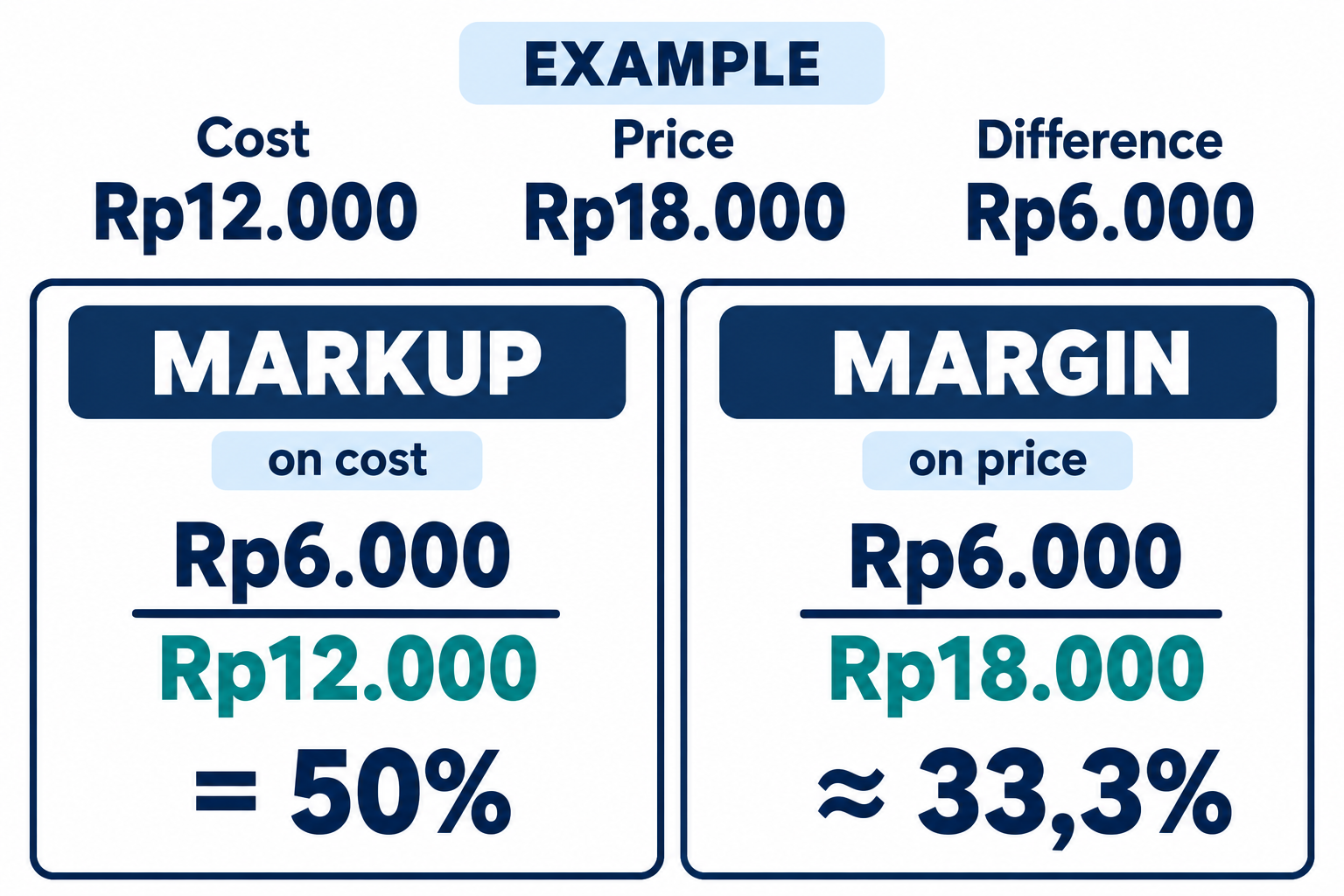
Suppose a serving costs Rp12,000 and sells for Rp18,000. The difference is Rp6,000. For markup, divide Rp6,000 by Rp12,000 to get 50%. For margin, divide Rp6,000 by Rp18,000 to get approximately 33.3%.
| Measure | Denominator | Result in this example |
|---|---|---|
| Markup | Cost of Rp12,000 | Rp6,000 divided by cost gives 50% |
| Margin | Selling price of Rp18,000 | Rp6,000 divided by price gives about 33.3% |
| Monetary difference | No percentage denominator | Rp18,000 less Rp12,000 gives Rp6,000 |
The denominator often disappears when a conversation refers only to “taking thirty percent”. Before approving a price, ask whether the percentage means markup, margin, commission or discount. Those terms describe different relationships and cannot be used interchangeably.
Define the cost being discussed
Write down the cost components and their unit. For a bakery product purchased and then served, the incoming product cost may differ from the cost of one saleable serving. Accompaniments, serving packaging and cutting yield may affect the calculation.
Use a consistent basis when comparing menu items. Do not include packaging for one item and omit it for another. If a cost is estimated, identify it as an estimate and retain its source.
The example margin is not automatically the business’s net profit. Operating expenses, waste, promotions and other components outside the calculation may reduce the final result. The measure needs a clear cost scope, not merely an attractive percentage.
Calculate a price from a clearly named target
With a 30% markup on a cost of Rp12,000, the example price is Rp12,000 multiplied by 1.30, or Rp15,600. The Rp3,600 difference represents a margin of approximately 23.1% on that selling price, rather than 30%.
If the intended target is a 30% margin, divide Rp12,000 by 0.70 instead. The result is approximately Rp17,142.86 before a rounding decision. Rounding is a separate choice: once the price is rounded, calculate the actual percentage again.
This relationship follows Shopify’s explanation of margin and markup. Use the formulas to understand the numbers, then select targets for your own circumstances. No single percentage is promised to suit every cafe or bakery category.
Test the effect of a discount
Suppose the Rp18,000 example price is discounted by Rp2,000 while cost remains Rp12,000. Sales revenue becomes Rp16,000 and the difference falls to Rp4,000. Margin on this example transaction is 25%; markup on cost is approximately 33.3%.
This makes clear why a sales discount should not be treated as a change to product cost. If there are other promotional expenses, record them separately according to the calculation basis you use. Percentages with different denominators cannot simply be added together.
Keep serving quantities and cost scope constant when comparing promotions. A selling-price change is easier to assess when it is not mixed with a different portion size or an extra bundle component that has not been costed.
Keep a calculation others can check
Record cost per serving, selling price, monetary difference, markup, margin and calculation date. State whether the price is before or after discounts and identify components excluded from the calculation. One transparent table is more useful than several unexplained percentages.
Ask a second person to calculate one example independently. If the results disagree, check the denominator and cost scope first. The formula may be sound while one colleague is referring to margin and another to markup.
Include a short note about what would require recalculation. A changed supplier quotation, a new serving size or an added accompaniment can invalidate the previous result even when the selling price stays unchanged. Review the affected inputs rather than copying last month’s percentage.
As a quick independent check, explain the Rp12,000 cost and Rp18,000 price without a calculator: the Rp6,000 difference is half the cost but only one-third of the selling price. That relationship can expose an implausible result before a spreadsheet is used. Then apply the precise calculation to the actual transaction figures while keeping the same serving unit throughout.
Begin with bakery cost per serving if the underlying cost is not yet consistent. When discussing supply choices with Asa Group, bring a clear product requirement and cost basis. Menu pricing remains your business decision, supported by assumptions and calculations that can be traced.